TL;DR
An AI-built app is a small, working piece of software created by describing what you want to an AI instead of programming it: a budget calculator, a team dashboard, a quiz, a booking form, a prototype. The maker is usually not a developer, the build takes minutes, and the result is almost always a web page (an HTML file) that runs in any browser. It's real software; what changed is who can make it and how fast.
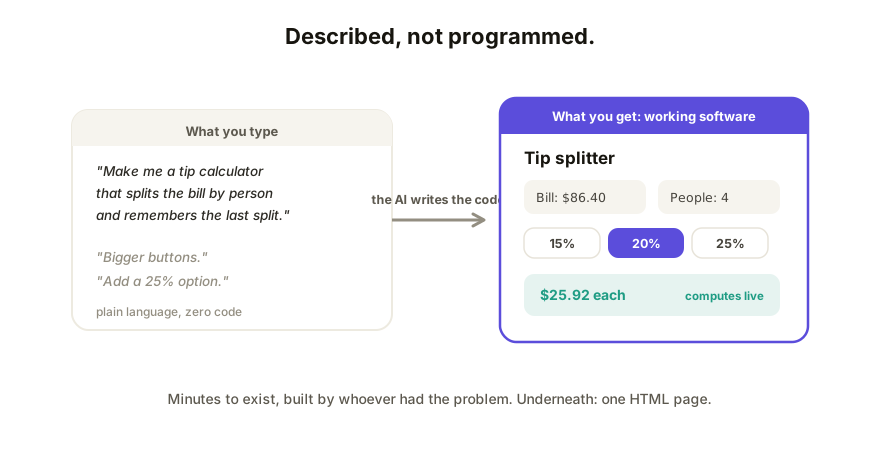
The definition, unpacked
"Small." AI-built apps are single-purpose: one calculator, one tracker, one report. They're not products with logins and databases; they're the software equivalent of a good spreadsheet: built for one job, often for one audience, sometimes for one meeting. That smallness isn't a weakness; it's why they can exist at all. Nobody was ever going to commission software for the offsite-planning vote.
"Working." Not a mockup, not a spec, not a picture of an app. The buttons compute, the filters filter. This separates the category from wireframes and from slideware: the recipient uses it (the artifact shift, in one word).
"By describing it." The maker writes what they want in plain language ("a tip calculator that splits by person and remembers the last split") and the AI writes the code. Iteration is more description: "make the buttons bigger," "add a weekly view." The maker may never see the code, and doesn't need to.
Where they come from
Every mainstream AI surface produces them, under different names: Claude's artifacts, ChatGPT's canvas, Gemini's apps (the naming decoder), and dedicated builders like v0 and Lovable that go from prompt to multi-page app. Under all of them, the output converges on the same substance: HTML, CSS, and JavaScript: the web's native format, chosen because it runs everywhere with no install.
What it is not: the neighboring categories
| Category | How it differs |
|---|---|
| No-code apps (Bubble, Glide) | Built by assembling in a visual editor; AI-built apps are described in language. No-code has more infrastructure (databases, auth), more learning curve. |
| Traditional software | Programmed, maintained, deployed by engineers; scales to products. AI-built apps trade that ceiling for minutes-to-exist. |
| Documents and slides | Read, not used. The app computes; the document describes (the boundary that's moving). |
| Mockups and wireframes | Pictures of software. An AI-built app is the software. |
The edges blur at the extremes (a heavily-engineered v0 project shades into traditional development), but the center of the category is stable: small, working, described into existence, by the person who had the problem.
The known limits
Honest edges, because the category's critics aren't wrong about them: AI-built apps are usually snapshot-data apps (paste numbers in; no live pipelines); regeneration can be erratic without version history; and the biggest gap is everything after the build: sharing, feedback, group editing, which the generating tools barely address (the missing half). The app takes minutes; making it usable by more than its maker is where the friction actually lives now.
How Coedit fits
Coedit is the layer for that after-the-build part: it takes an AI-built app from any tool and gives it one live link where anyone can open it with no account, comment on the exact element, edit copy and styling without code, and roll through one version history that includes agent changes. It never builds the app; by the definition above, that job is taken.
FAQ
Q: What is an AI-built app, in one sentence? A: A small, working piece of software (calculator, dashboard, tool, prototype) created by describing it to an AI in plain language rather than programming it.
Q: Are AI-built apps real apps? A: Yes: real running code, almost always a web page, fully interactive in any browser. They're distinguished from traditional software by scale and origin, not by being fake.
Q: Do I need to know how to code to make one? A: No, and that's the point of the category. You describe; the AI writes the code. Coding knowledge only becomes relevant if the app outgrows the category into a maintained product.
Q: What's the difference between an AI-built app and an artifact? A: Same thing at different zoom: "artifact" is the AI tools' container word for substantial output (Claude popularized it); "AI-built app" names the interactive subset that behaves like software.