TL;DR
The AI stack has a strong left half and a missing right half. Models, copilots, and app generators cover making things astonishingly well. What happens after the thing exists (sharing it, reviewing it, editing it together, keeping its history) is still mostly email attachments and screenshots. That after-the-output half is the collaboration layer, and it's where AI work currently leaks value.
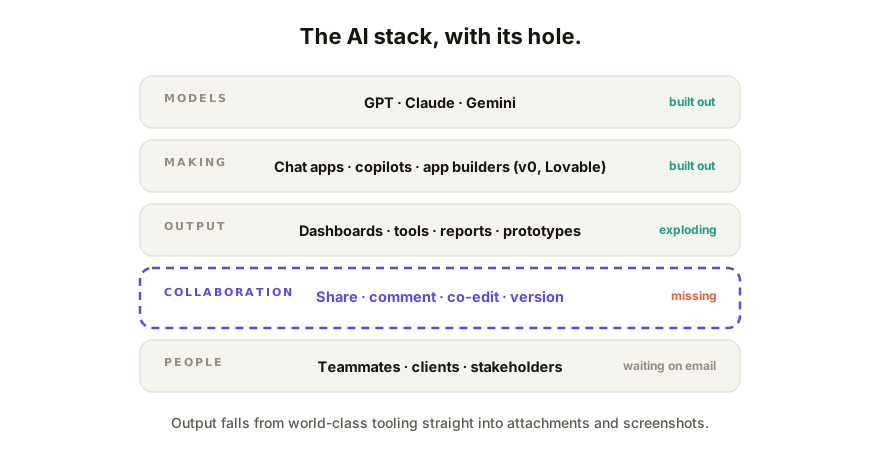
The stack, as it actually stands
Sketch the layers of how AI work gets made and used, and the imbalance is hard to miss:
| Layer | What it does | State |
|---|---|---|
| Models | GPT, Claude, Gemini: the raw capability | Crowded, excellent |
| Generation tools | Chat apps, copilots, app builders (v0, Lovable) | Crowded, excellent |
| The output | Working pages, dashboards, tools, reports | Growing exponentially |
| Collaboration | Share, review, co-edit, version the output | Mostly missing |
| The audience | Teammates, clients, stakeholders | Waiting on email |
Billions of dollars and thousands of teams compete on the top two layers. The bottom layer, the people the work is for, hasn't changed. And the layer connecting them barely exists: output falls from world-class generation tooling straight into the oldest distribution methods we have. A file. A screenshot. A read-only link.
Why generation tools don't just fill the gap
The obvious question: won't Claude, ChatGPT, and Gemini simply add collaboration? They keep adding sharing features, but three structural things keep the vendor share button from becoming the layer.
They optimize for the maker, correctly. A generation tool's job is the person prompting. Collaboration serves everyone else: the client with no account, the teammate on a different AI, the reviewer on a phone. Different user, different product. Vendor sharing stays view-only because view-only is the natural stopping point when your product is the conversation (the limits, tool by tool).
They can't be neutral. Real teams are multi-tool: marketing on ChatGPT, the founder on Claude, a contractor on v0. A collaboration surface owned by one vendor works for one slice of the output and pulls everyone toward its accounts and plans. The layer that spans the stack has to be a layer, not a feature of one column, the same way Google Docs didn't belong to Word.
Collaboration is its own hard problem. Concurrent edits from several people and agents on the same artifact without conflicts, comments anchored to elements that survive edits, history across human and agent changes: this is CRDT-and-merge territory, a different engineering discipline than generation. It gets built well by someone for whom it's the entire product.
What filling the gap looks like
Concretely, the layer needs to deliver the loop: share, comment, edit, reshare.
- One live link per artifact, tool-agnostic on the way in.
- Zero-friction access: viewing and commenting with no account.
- Feedback pinned to the exact element it's about.
- Editing without code, so the non-technical half of the team participates directly.
- One version history covering humans and agents, with rollback.
None of these is exotic. What's new is applying them to the new unit of work: not documents, but small working apps, which is the shift the pillar essay maps. The precedent is exact: spreadsheets existed for decades before the browser made them multiplayer, and the multiplayer turn is what moved them from personal tools to where teams actually run.
How Coedit fits
Coedit is a bet on that missing half, built deliberately as a layer: it never generates (the top of the stack has that covered), it accepts HTML from any tool or none, and it does the loop: live link, no-account viewing and commenting, no-code edits, and one rollback-able history across human and agent changes, on CRDT foundations (47/47 concurrency tests, 9/9 round-trip suites). The full definition of the category, with what is and isn't a collaboration layer, is in what is a collaboration layer?
FAQ
Q: What is the collaboration layer in the AI stack? A: The layer between generated output and its audience: the software that takes what AI tools produce and makes it shareable, reviewable, editable, and versioned by a group. Generation tools cover making; the collaboration layer covers everything after.
Q: Why is collaboration the missing piece rather than, say, hosting? A: Hosting exists and works; it serves finished work to the public. What's missing is the loop before finished: feedback on the work itself, edits by non-coders, history. Distribution without collaboration just ships the first draft faster.
Q: Won't the model companies build this themselves? A: They'll keep improving sharing for their own output. The structural problem is neutrality: teams use several AI tools, and a layer owned by one vendor can't be the shared surface for all of them, any more than one bank's app could be everyone's payment layer.