TL;DR
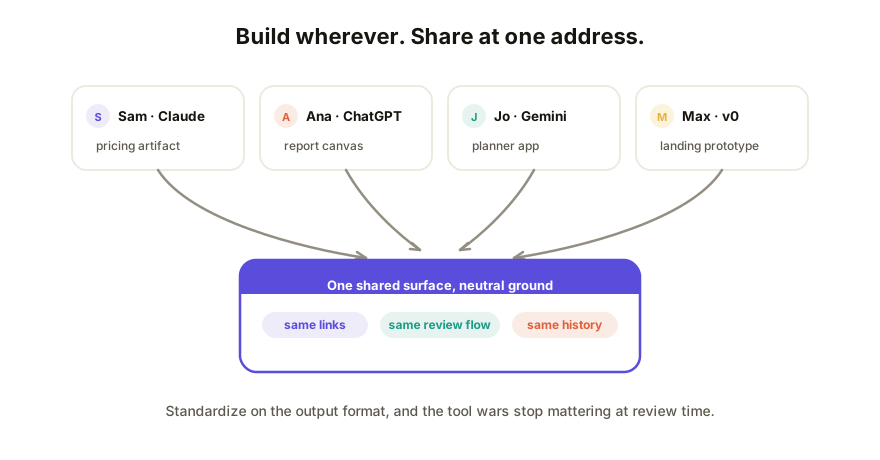
Real teams don't standardize on one AI tool, and shouldn't have to. But every tool shares its output differently (view-only links on different domains, different rules, none interoperable), so a three-tool team ends up with three broken sharing workflows. The fix isn't picking a winner. It's standardizing one level down, on the output format: everything these tools build is HTML, so one shared surface can hold all of it, and the tool wars stop mattering at review time.
The multi-tool team is the normal team
The analyst likes ChatGPT. The founder builds in Claude. Someone's trying Gemini because it came with the workspace, and the designer prototypes in v0. None of them is wrong; the tools genuinely differ, and they leapfrog each other monthly, which is exactly why forcing a single choice is a losing move.
The cost shows up at the seams. Each tool's output lives behind its own share mechanism (artifact links, conversation shares, canvas links: the full decoder), so the team's work is scattered across vendor domains with different access rules, and cross-tool collaboration degrades to the lowest common denominator: screenshots in Slack.
Standardize on the format, not the tool
Here's the piece of luck: underneath the branding, every one of these tools emits the same thing. Interactive output is an HTML page, whether it came out of a chat or an app builder. That means the interoperability problem is already solved one level down, and the workflow follows:
- Build anywhere. Each person keeps their tool, their prompts, their pace.
- Publish the output to one shared surface. Export the HTML (every tool can) and give it a live link on neutral ground: same address format, same access rules, whoever made it.
- Review, comment, and edit in one place. Comments pin to elements; non-coders fix the copy; history accumulates per artifact, regardless of source.
- Iterate back in the tool of origin and republish to the same link.
The rule fits on an index card: build wherever, share at one kind of address. Teams already run this pattern for documents (write in whatever editor, share the Doc link) without noticing it's a policy.
What you get for it
- One review habit. Nobody learns four sharing systems; a share from the Gemini experimenter behaves exactly like one from the Claude power user.
- Audience access stops depending on the maker's vendor. Clients open one kind of link with no account, always, instead of "this one needs X, that one needs Y."
- The work outlives the tool choice. Swap Lovable for v0 next quarter; every already-shared artifact keeps its address, comments, and history. No migration, because the surface never belonged to the generator.
- Fair comparisons. When two people prototype the same idea in different tools, both land side by side on the same surface, judged on the work rather than the sharing friction.
The strategic version of this argument (why the shared surface must be neutral, and why generators can't be it) is the missing-half essay; the tactical version is above.
How Coedit fits
Coedit is built to be that neutral surface: it accepts HTML from Claude, ChatGPT, Gemini, Lovable, v0, or a text editor, and gives every artifact the same live link with no-account viewing and commenting, no-code editing, and one version history across human and agent changes. It generates nothing, on purpose: a surface that competed with your generators couldn't stay neutral across them. One team, any tools, one kind of address.
FAQ
Q: How do teams using different AI tools share work in one place? A: Standardize on the output, not the generator. Every AI tool's interactive output is HTML, so export it and publish to one tool-agnostic surface where all of it gets the same link format, review flow, and history.
Q: Should our team just pick one AI tool instead? A: Picking one simplifies billing, not collaboration, and costs you wherever the other tools are stronger. The sharing problem is solved more cheaply at the output layer, which also keeps you free to switch tools as they leapfrog.
Q: Does this work for app builders like v0 and Lovable too? A: Yes: their output is HTML like everyone else's, and the same build-there-review-here loop applies. Details in the v0/Lovable guide.
Q: What happens to shared work if we drop one of the tools? A: Nothing. The shared copies live on the neutral surface with their comments and history intact; only the place you generate next month changes.